Conventional wisdom says: open plan doesn’t work. Conventional wisdom says: private offices stifle collaboration. Conventional wisdom says: noise in open plan is distracting. Conventional wisdom says: silence in the workspace is the enemy of creativity. And let’s not even get into the war between work from home vs work in office advocates. Can all of this be true? Can conventional wisdom contradict itself and still be considered wisdom?
The answer: it depends.
The office is an amalgam of different tasks performed by different people. Some of those tasks require silence and solitude while others do not. For decades the push for standardization forced all workers with different tasks into the same workspace. The logic behind standardization was that it saved money and made furniture parts easy to manage. Having been through many facility managers warehouses of workstation parts, I find the latter claim a dubious one. More significantly, science tells us the former claim is erroneous. Putting everyone in the same workstation in an effort to save money ended up costing companies in lower employee engagement and productivity (think Dilbert). And let’s remember that 82% of the average companies operating costs are people, not space and furniture.

Science tells us that one of the factors that increases employee engagement is aligning the work performed with the space and furniture to support it. So how do we determine what work is being done and how to support it? It’s based on knowledge and interaction.
Knowledge: Is the work being done strategic and long term or tactical and short term in nature? Interaction: Does the work being done require interaction with others to accomplish?
Note that these definitions are based on the work that is being done and does not send us down the rabbit hole of worker personality types. With regards to workstyles, we do not consider personality types. Rather, we seek to create a space that supports the work being done. When you base it on that criteria, it looks like this:
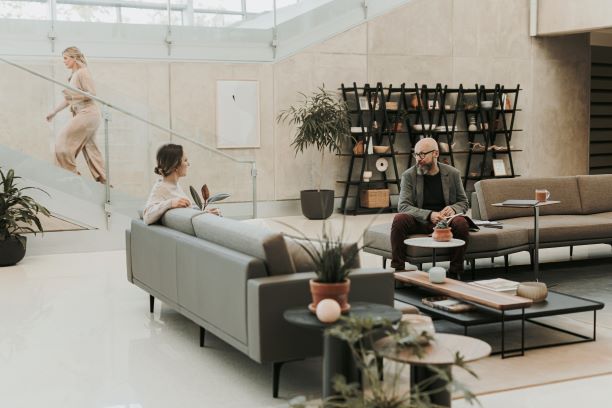
4 Types of Workstyles:
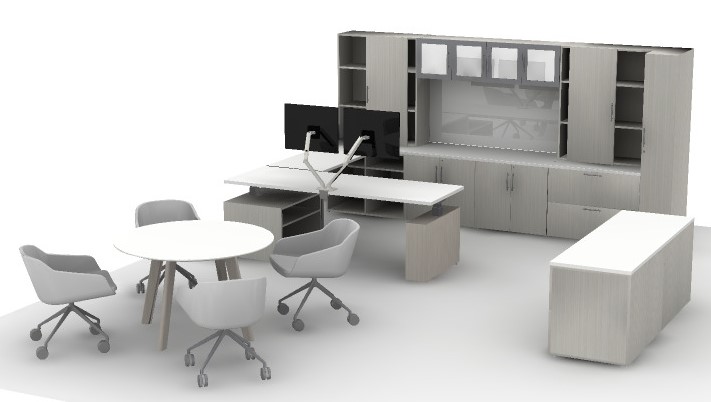
- Master Workstyle: Working alone on strategic objectives, such as CEO or CFO. This is the typical private office, which provides the user privacy and space to seek inspiration, insight and vision to set long term strategy and work on long term obstacles.
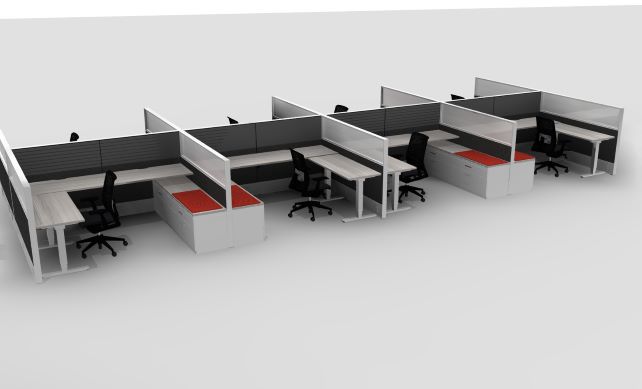
- Specialist Workstyle: This person is working alone on tactical objectives, like a bookkeeper or CAD operator. These users are doing heavy focus work on short term deliverables. Their space requires speech privacy, low interaction, and imbedded storage – picture the typical 6×8 cubicle with high panels from the Dilbert cartoons.
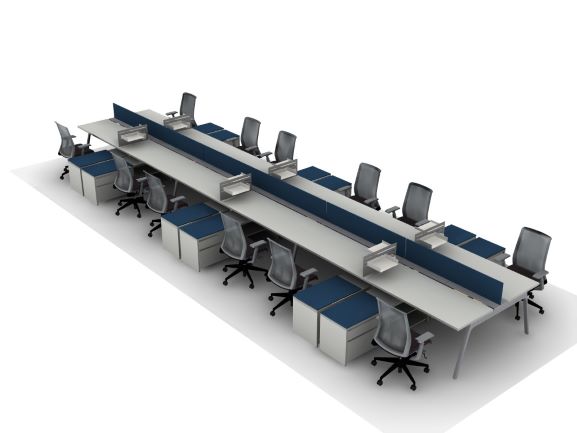
- Connector Workstyle: Working together on strategic objectives, this workstyle is typified by the marketing group, sales group or any department that brainstorms to come up with solutions to long term objectives. Benching, where there is little division between users, works well in this environment.
- Crew Workstyle: It has been suggested by some researchers that this is, by far, the most common workstyle in the US. These are people working together on tactical objectives. These users will have space to do focus work and have strategically embedded areas, in their workstations, to collaborate. They will have a mix of personal and shared storage, with low or no panels between the team members.

- How can one office support all these different types of work? Understand that ALL of these workstyles can be accomplished in about the same footprint with the same kit of parts. Are you planning to provide each employee with a 6×8 workstation? Each of these workstyles can be supported in that space.
Consider the above definitions and then consider this: If the most common workstyle is Crew, yet the most common workstation type we see in the field suits a Specialist workstyle, what does that say about how we are supporting office workers? What does it say about productivity and employee engagement? And what does it say about the conventional wisdom from the beginning of this article?

Upon reflection, it becomes quite clear that it really does depend on the type of work being done and how best to support it. When companies support the work being done by employees with the proper space and workstation, they unleash the potential of that knowledge worker who is costing them 82% of their operating expenses. They are helping create employee engagement, reinforcing their organizational culture and their company brand. When the best companies accomplish this, the sky is truly the limit.

Authors:
Michael Furnari LEED AP + WELL AP
Territory Sales Manager, Haworth
“ Michael is a student of business and a believer in the power of space to create engaged, innovative work groups. He has helped dozens of clients in Central Florida use space as a tool to achieve their business objectives”
Erin Schultz, CBRE
Director, Market Leader for Tampa & Orlando, CBRE
“Erin believes a strong management process can create great spaces for clients. Her multi-disciplinary experience and approach have helped some of the largest corporations in the country create effective and cost-efficient facilities”